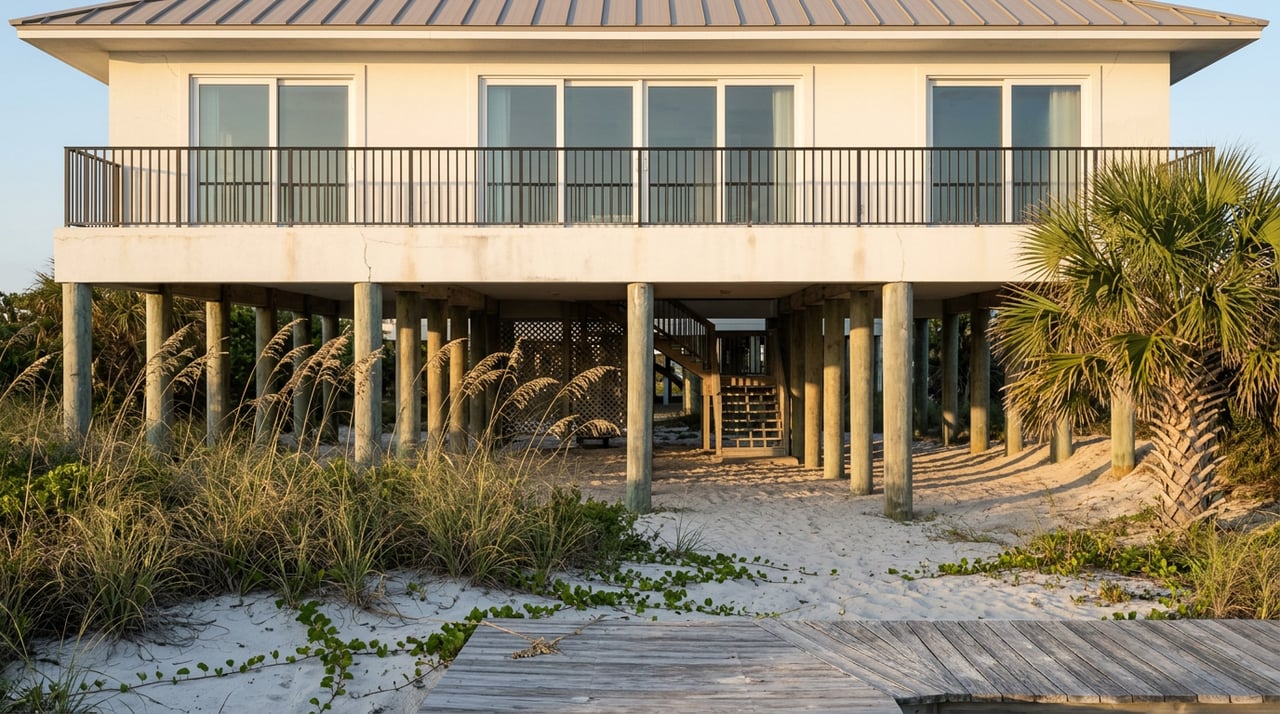
A buyer under contract on a 1970s Gulf-front cottage on Panama City Beach calls the builder to talk about a second-floor addition. The builder asks a question the buyer has never heard before: is the house seaward of the control line? The buyer assumes this is a formality. It is not. It is the difference between a straightforward county permit and a second review process, run by a state agency in Tallahassee, that can add months and tens of thousands of dollars to a project the buyer thought was already priced out.
That line is the Coastal Construction Control Line, or CCCL, and Florida Administrative Code Rule 62B-26.024 establishes it along the Gulf in Bay County. Most agents mention it once during disclosure and move on. It deserves more attention than that, because the common assumption about what the line does is wrong, and the correct version of the story changes how a Gulf-front buyer should budget, plan, and negotiate.
The line does not do what most buyers think it does
The instinct is to treat the CCCL like a boundary you cannot cross: build on this side, forget it on that side. That is not what it is. The Florida Department of Environmental Protection's own guidance for homeowners is direct on this point: there is no prohibition against rebuilding seaward of the control line. The CCCL is not a setback. It is a jurisdictional line, meaning it marks where the state, not just the county, gets a say in how you build.
That distinction matters because it reframes the real question. It is not "can I build here." It is "how many permitting desks does my project have to clear, and what does each one require." For a Gulf-front lot in Panama City Beach, whether a project falls seaward of the CCCL affects whether it requires a separate review by the Florida DEP.
What actually triggers the second review, and what skips it
Not every project seaward of the line needs a full DEP permit. The exemptions are specific enough that they are easy to misread from a distance, which is exactly why they cause friction mid-transaction rather than before closing.
| Activity | Typically exempt from DEP review | Typically requires DEP review |
|---|---|---|
| Landscape plantings 30+ feet landward of the dune, no excavation, no removal of native salt-tolerant vegetation | Yes | |
| New habitable structure or addition seaward of the CCCL | Yes | |
| Pool excavation near an existing habitable structure | Yes | |
| Rebuild or major renovation that expands the existing footprint | Yes |
The pattern in that table is worth sitting with. The exemptions almost all depend on distance from the dune and on whether excavation happens. A buyer who assumes their planned pool is a simple add-on because it is common everywhere else in Florida can find out mid-permitting that the excavation for that specific pool, on that specific lot, moved the project into DEP's lane.
When a project does need DEP review, the technical requirements are not minor. Habitable structures and additions built seaward of the CCCL must be supported on pilings under Florida Building Code Section 3109.4.1, and pools near those structures need their own piling foundation under 3109.7, with plans certified by a Florida-licensed engineer or architect. That is not a box-check. It is an engineering requirement that shapes design, cost, and timeline from the first drawing.
The paperwork a seller cannot make disappear with a handshake
Florida law does not leave this to chance at the negotiating table. Section 161.57 of the Florida Statutes requires a seller of property affected by the CCCL to disclose that fact, either in the sale contract or in a separate written instrument, and to provide the buyer with either a survey or an affidavit showing where the line falls on the property, unless the buyer waives that right in writing.
In practice, Lowndes reports that sellers often ask buyers to sign that waiver, which shifts the job of locating the CCCL onto the buyer's side of the table. That is a reasonable thing for a seller to request, and it is a reasonable thing for a buyer to decline. A buyer who waives the survey and later discovers their planned addition sits seaward of the line has no one else to hand that discovery to. It becomes their timeline, their engineer, their budget.
A CCCL disclosure waiver moves the paperwork off the closing table. It does not move the line off the lot.
What compliance actually buys you, in dollars
The state's interest here is not paperwork for its own sake. After Hurricane Opal struck the Florida Panhandle in 1995, FDEP's own accounting found that 768 of the structures built without CCCL permitting, roughly 40 percent of that group, were destroyed. Of the structures that had gone through CCCL permitting, only 2 out of 576, a small fraction, were destroyed. That gap is the entire argument for the pile requirements and the engineering review, and it is also the argument an insurer makes when pricing a policy on a Gulf-front structure.
For a Panama City Beach buyer weighing a rebuild against a renovation of an older beach cottage, the cost math tracks that same gap. Standard custom construction in the area typically runs in the $200 to $400 per square foot range, while a Gulf-front build with the coastal-specific engineering the CCCL requires typically lands between $400 and $800 or more per square foot. Lot pricing follows the same split: inland parcels can run from roughly $3,000 to $50,000 an acre, while Gulf-front and near-beach parcels can run $50,000 to $150,000 or more an acre. Layer in the regional impact fee increases that took effect in October 2024, up somewhere between 17 and 45 percent depending on category, and the gap between an inland renovation and a Gulf-front rebuild widens further before a single piling goes in the ground.
None of that is a reason to avoid Gulf-front property. It is a reason to have the CCCL conversation before writing an offer rather than after the inspection period, so the number attached to the rebuild or the addition is the real one, not the one that assumed the county desk was the only desk.
Before you write the offer
The practical version of all of this is short. Ask whether the CCCL crosses the specific lot, not just whether the neighborhood is generally coastal. Ask for the survey rather than signing the waiver by default, especially if any part of your plan involves a footprint expansion or excavation. And if a rebuild or addition is part of the plan, get the DEP question answered by a licensed engineer or architect before the budget gets set, not after.
A few common questions
Does the CCCL apply to condos, or only single-family homes? The jurisdiction applies to the land and structures within it regardless of building type, though for a condominium the CCCL question typically gets handled at the association or developer level rather than by an individual unit owner.
What if the lot's existing survey does not show the line? FDEP maintains an interactive mapping tool that shows the CCCL location by county, and a licensed surveyor can plot it against a specific parcel. This is the step a buyer skips when they sign a disclosure waiver, and the step worth insisting on before closing if a rebuild is part of the plan.
Does a CCCL permit slow down a purchase itself, or only future construction? The CCCL only becomes a bottleneck when someone applies for a building permit for new construction, a footprint expansion, or certain repairs, which is why the disclosure step matters even for buyers with no immediate renovation plans.
Gulf-front property in Panama City Beach carries a different set of questions than a home a few streets back from the water, and the CCCL is one most buyers do not think to ask until a contractor asks it for them. If you are weighing a Gulf-front purchase, a rebuild, or a renovation on a lot that might sit seaward of the line, Bode at the Beach can help you get the survey question answered before it becomes a budget question. Start Your Beach Search today.
This article is general information, not legal, tax or financial advice. Consult a qualified professional about your situation.